English
 中文简体
中文简体

Manual fluid transfer pumps are among the most practically useful tools in workshops, industrial facilities, agricultural operations, and commercial maintenance environments. The ability to move viscous fluids such as engine oil, hydraulic fluid, gear oil, grease, and lubricants from storage containers into machinery or between vessels without requiring electrical power or compressed air makes the hand operated oil pump, hand operated grease pump, and rotary pump for barrels genuinely essential across a wide range of industries. These tools work wherever power is unavailable, where the fluid volume does not justify a powered system, or where the simplicity and reliability of a manual mechanism is preferable to the complexity of an electrically driven alternative.
The direct conclusion for anyone evaluating these three product types is this: a hand operated oil pump is correct for transferring liquid oils and low viscosity fluids from drums and barrels; a hand operated grease pump is the appropriate tool when the fluid to be transferred or dispensed is a semi solid grease or heavy paste that requires a specialized pump mechanism with sufficient force to move the material; and a rotary pump for barrels is the most efficient hand powered option when a consistent, continuous flow of liquid from a standard 200 liter drum is required with minimal operator effort per liter transferred. This article covers all three types in full practical depth.
Hand Operated Oil Pump: Design, Function, and Applications
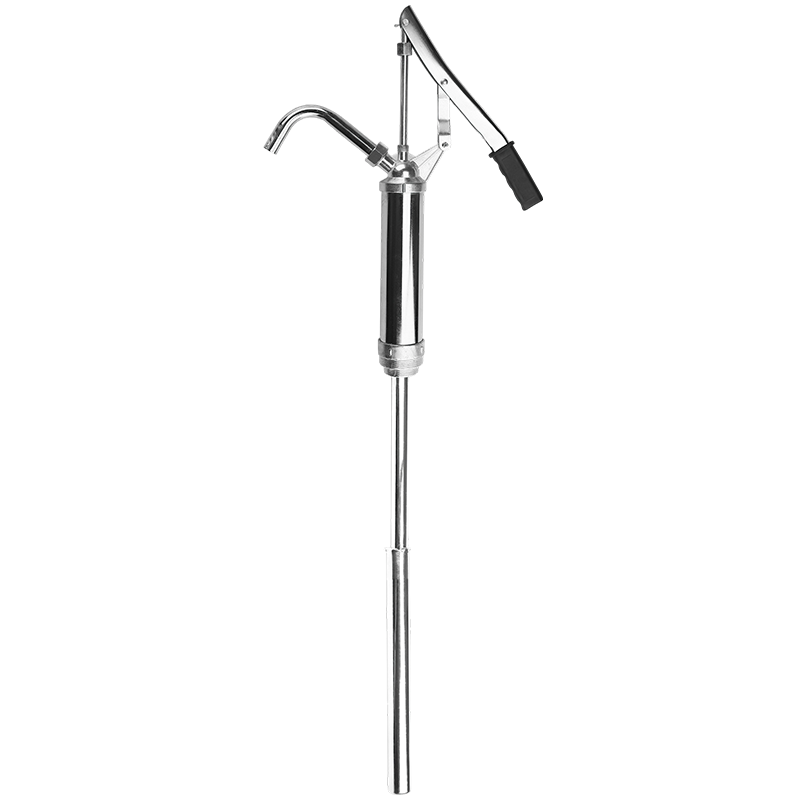
A hand operated oil pump transfers liquid oils and fluid lubricants from storage containers such as drums, IBC totes, and storage tanks to equipment sumps, reservoirs, and transfer containers by manual mechanical action. The most common mechanism is a piston pump in which a reciprocating handle drives a piston up and down within a cylinder, with check valves at inlet and outlet that ensure fluid moves in only one direction through the pump body on each stroke. The operator applies downward force to the handle, the piston moves, and fluid is drawn from the inlet on the upstroke and discharged through the outlet on the downstroke.
Lever Ratio and Flow Rate in Hand Operated Oil Pumps
The efficiency of a hand operated oil pump is determined by the displacement volume of its piston per stroke and the mechanical advantage provided by the lever handle. Most piston type hand operated oil pumps deliver 0.2 to 0.5 liters per stroke, meaning that transferring 10 liters of engine oil from a drum requires approximately 20 to 50 pumping strokes. Quality hand operated oil pumps designed for drum service use a long lever with a 3:1 to 5:1 mechanical advantage ratio, allowing the operator to overcome the viscosity resistance of oils with ISO VG grades up to 320 without excessive effort even at low temperatures when oil viscosity increases significantly. The suction tube length is typically 800 to 1,000 mm, designed to reach the bottom of a standard 200 liter drum when the pump head is mounted on the bung opening at the top.
Materials and Fluid Compatibility
Hand operated oil pumps are produced in materials matched to the chemical compatibility requirements of the fluids being transferred:
- Steel construction with NBR seals: The standard configuration for petroleum based oils including engine oil, hydraulic fluid, gear oil, and mineral based lubricants. NBR (nitrile butadiene rubber) seals resist petroleum hydrocarbon based fluids effectively and are the appropriate seal choice for standard workshop oil transfer applications.
- Stainless steel or aluminum with Viton seals: Required when the fluid being pumped is a synthetic oil, fuel, solvent, or other fluid with chemical properties that degrade standard NBR seals. Viton (fluoroelastomer) seals resist a much broader range of chemical environments and are the correct choice for synthetic lubricants, biodiesel blends, and petroleum fluids with additive packages that attack NBR.
- Polypropylene or polyethylene construction: Used for food grade oils, water based fluids, and mild chemical solutions where metal contact must be avoided. Plastic body pumps are lighter and corrosion immune but have lower pressure capability and are not suitable for heavy viscosity oils.
Hand Operated Grease Pump: Moving Semi Solid Lubricants
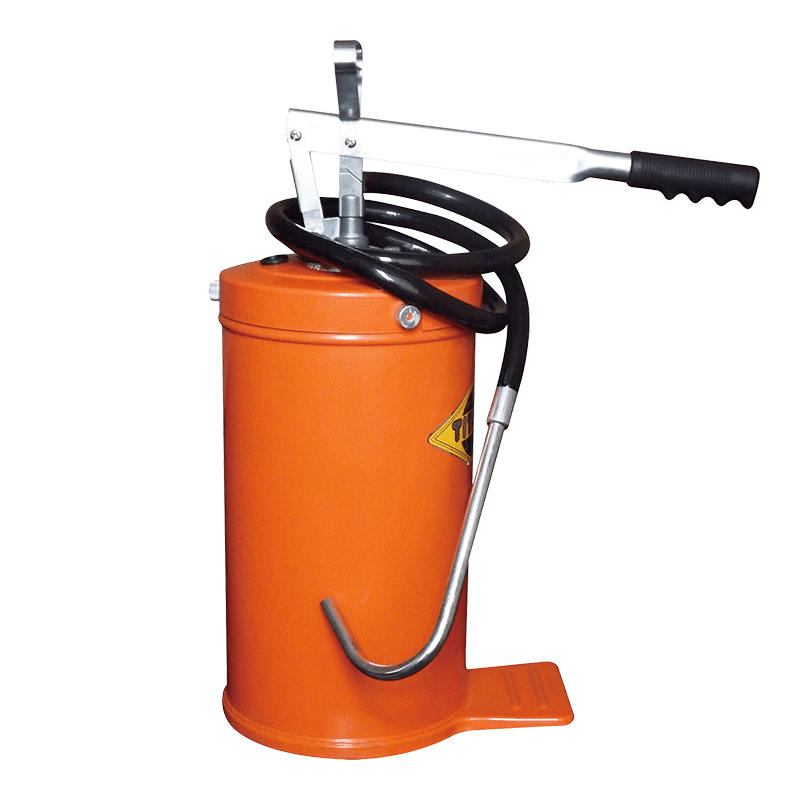
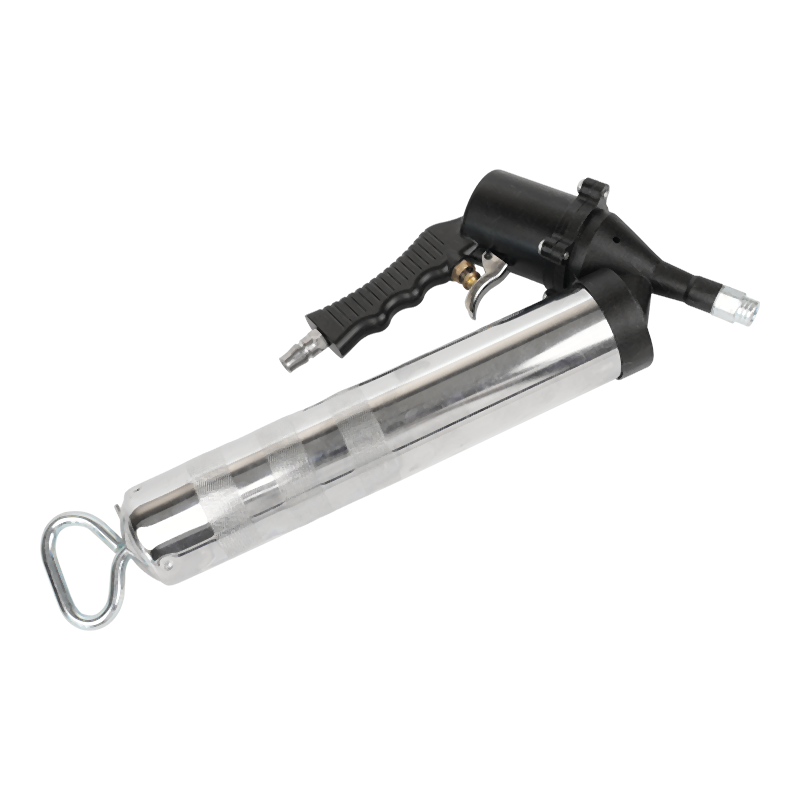
A hand operated grease pump addresses a fundamentally different fluid transfer challenge from a hand operated oil pump. Grease is a semi solid material consisting of a base oil thickened with a soap or polymer thickener to a consistency ranging from soft paste (NLGI Grade 0 or 1) to firm solid (NLGI Grade 3). This consistency means that grease cannot flow under its own weight and cannot be moved by suction alone: it requires positive displacement force to move it through a pump body, delivery tube, and outlet fitting. The hand operated grease pump provides this force through a high leverage piston mechanism capable of generating delivery pressures sufficient to move grease through the pump system and into lubrication points on machinery.
Construction of a Hand Operated Grease Pump
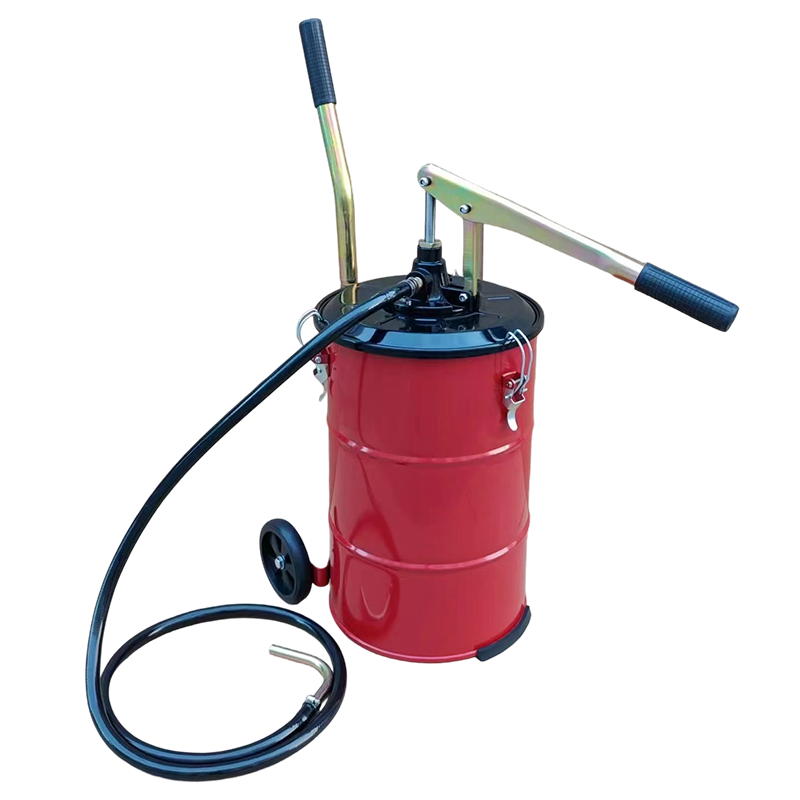
Hand operated grease pumps designed for bulk grease dispensing from drums or pails use a follower plate that rests on the surface of the grease in the container and is forced downward as the container empties, preventing air pockets from forming above the grease that would cause the pump to cavitate. The pump piston enters from above through the follower plate, drawing grease upward and through the check valves on each pumping stroke. Quality hand operated grease pumps generate delivery pressures of 40 to 80 MPa (400 to 800 bar) at typical operating lever forces, sufficient to overcome the back pressure of bearing nipples and deliver NLGI Grade 2 grease effectively even at low temperatures where grease stiffens significantly.
The delivery hose of a hand operated grease pump must be rated for the full delivery pressure of the pump. Braided steel reinforced hoses with swaged end fittings are the appropriate specification for high pressure grease pump applications. Standard flexible plastic hoses rated for oil service are not adequate for grease pump pressures and should not be used as substitutes.
Drum Mounted vs Portable Grease Pump Configurations
Hand operated grease pumps are available in two primary configurations suited to different working environments:
- Drum mounted configuration: The pump assembly is mounted permanently to the top of a standard 20 kg or 200 kg grease drum through a threaded or clamped connection to the drum opening, with the follower plate descending into the drum as grease is dispensed. This is the most efficient setup for a workshop that consumes grease in volume, providing immediate access to grease without container handling at each use.
- Portable or bench mounted configuration: A smaller pump designed to draw from a grease pail, cartridge, or small container, carried to the machine being serviced. Portable hand operated grease pumps are suited to field maintenance and mobile service operations where the technician moves between machines rather than bringing machines to a workshop.
Rotary Pump for Barrels: Continuous Flow from Standard Drums
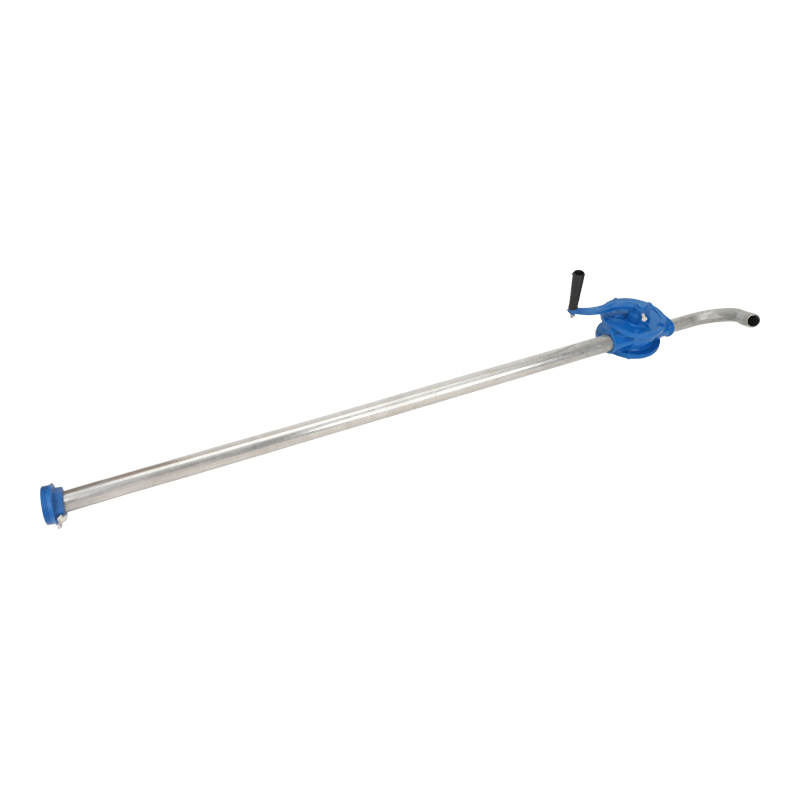
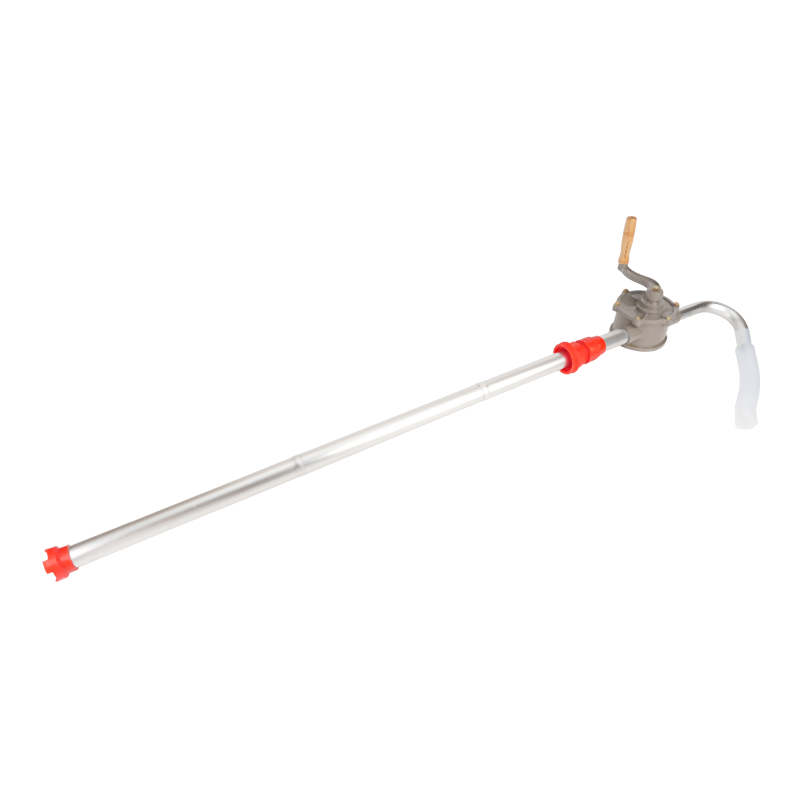
A rotary pump for barrels is a hand powered pump that uses a rotating rather than reciprocating mechanism to transfer fluid from a drum, and is specifically designed to mount directly into the bung opening of a standard 200 liter steel or plastic drum. The rotary mechanism converts continuous handle rotation into continuous fluid displacement, producing a steady flow of fluid at the outlet rather than the pulsed flow of a reciprocating piston pump. This makes the rotary pump for barrels the preferred tool when a substantial volume of fluid must be transferred efficiently, as the continuous rotation is less tiring than the up down pumping motion of a reciprocating lever pump over extended transfer sessions.
Rotary Pump Mechanism and Flow Rate
The most common rotary pump mechanism for barrel service is the gear pump or vane pump design. In a gear pump, two intermeshing gears rotate within a closely toleranced pump housing: fluid is trapped between the gear teeth and the housing wall on the intake side, carried around the outside of the gear mesh, and displaced from the outlet as the gear teeth mesh again and reduce the tooth space volume. A standard rotary barrel pump with a 500 mm suction tube delivers approximately 0.5 to 1.0 liters per revolution of the handle, allowing 10 liters of engine oil to be transferred in 10 to 20 complete handle rotations, which takes an experienced operator approximately 30 to 60 seconds. This flow rate is 3 to 5 times faster than an equivalent reciprocating piston pump for the same operator effort level.
Viscosity Limitations of Rotary Barrel Pumps
The rotary pump for barrels excels with low to medium viscosity oils but has limitations with very thick fluids. Unlike piston pumps that can generate very high pressures to move viscous material, rotary gear and vane pumps rely on close clearance fit between rotating elements and the housing to prevent backflow, and this clearance increases as the pump wears. For oils with ISO VG grades above 460, or for grease in any grade, the rotary pump mechanism is not appropriate: the high internal clearances needed to allow rotation without seizing create too much slip for high viscosity materials. Rotary barrel pumps are rated for viscosities up to approximately 500 to 1,000 cSt depending on the specific pump design, covering the majority of mineral engine oils, hydraulic fluids, and gear oils used at ambient workshop temperatures but excluding very heavy gear oils, residual fuel oils, and all grease formulations.
Comparing the Three Hand Operated Pump Types
| Specification | Hand operated oil pump | Hand operated grease pump | Rotary pump for barrels |
|---|---|---|---|
| Mechanism type | Reciprocating piston | High pressure piston with follower plate | Rotary gear or vane |
| Fluid compatibility | Liquid oils up to ISO VG 320 | NLGI Grade 0 to 3 greases | Liquid oils up to 500 to 1,000 cSt |
| Flow rate | 0.2 to 0.5 L per stroke | 5 to 15 grams per stroke | 0.5 to 1.0 L per revolution |
| Operating pressure | 1 to 5 MPa (low to moderate) | 40 to 80 MPa (high) | 0.1 to 0.5 MPa (low) |
| Typical container | Drum, barrel, IBC tote | 20 kg pail or 200 kg drum | Standard 200 liter drum |
| Best application | Oil changes, fluid top up, moderate volume transfer | Bearing and nipple lubrication, grease dispensing | High volume liquid oil decanting from drums |
Maintenance and Safe Use of Hand Operated Fluid Pumps
All three categories of hand operated pump share common maintenance and safe use requirements that determine their service life and reliable performance over time. The following practices apply across the range:
- Verify fluid compatibility before each new fluid application. Using a pump that is not chemically compatible with the fluid being transferred leads to seal degradation, pump body corrosion, and fluid contamination. Always check that the pump seal material (NBR, Viton, or polymer) is rated for the specific fluid, especially when switching between fluid types.
- Flush the pump when changing between fluid types. Residual fluid left in the pump body and suction tube from a previous use can contaminate the next fluid. Flush by pumping a small quantity of the new fluid through the pump and discarding it before directing flow to the receiving container.
- Inspect and replace seals at the first sign of leakage. Seals in reciprocating pumps wear over time and will eventually show leakage past the piston. Continued use with worn seals reduces pump efficiency, contaminates the external surfaces, and can lead to pump body damage if abrasive particles enter the worn seal clearance. Replacement seal kits are available for most quality pump models and should be stocked as a spare part.
- Store pumps clean and dry when not in use. Leaving a pump containing oil or grease in storage for extended periods allows the fluid to oxidize or separate, potentially blocking the check valves and inlet passages. Clean the pump through and store it dry, or with a small amount of clean mineral oil as a preservative in oil pump applications.
- Use the correct suction tube length for the container being used. A suction tube that does not reach the bottom of the container leaves a significant quantity of fluid unrecoverable, particularly wasteful with expensive lubricants. Measure the container depth and use the appropriate suction tube length or extension to recover as much fluid as possible from each container.
Hand operated fluid pumps deliver their value through simplicity, reliability, and independence from power sources. Matching the correct pump type to the fluid being handled, the container being used, and the volume and pressure required by the task produces efficient, contamination free fluid transfer without the equipment cost, power requirements, or maintenance complexity of motorized alternatives. For the majority of workshop, agricultural, and industrial fluid handling tasks that do not justify a powered system, the correct hand operated pump is the most practical and cost effective solution available.